



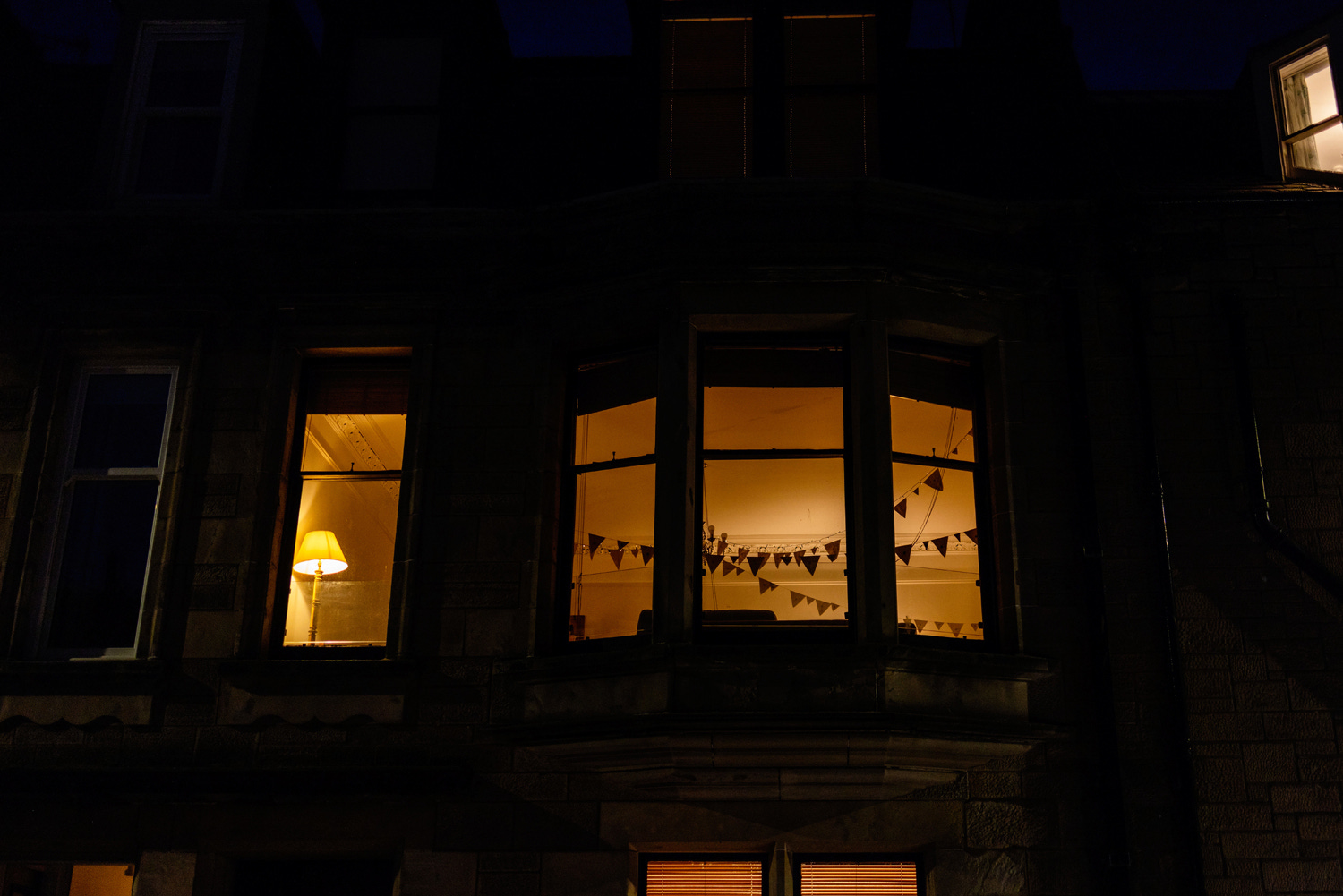
If I hadn’t been tipped off to it, I don’t know if I would ever truly noticed.
Sure, I’d paid attention whilst wandering at night through dozens of strange cities, both foreign and domestic. Sure I’d seen the floor to ceiling windows fronting a house or apartment, but I don’t know if I ever registered the lack of curtains, the lack of closed blinds.
Walk around enough cities at the blue hour and beyond and you’ll become a connoisseur of a million lives you’re not living, you’ll grow accustomed to looking in and feeling your mind wander off, imagining what it’d be to call that place home. I’ve played this game with myself all my life when in places unfamiliar, looking up, looking over, seeing the warm yellow light pouring from the windows above or across from me, seeing the furniture placed, the art on the walls, the bits and bobs that live on the shelves, little tchotchkes worthy enough to be bought or saved. Until I read a certain article though, I don’t know if I thought much beyond that.
The Atlantic ran an article two years ago called “Why Rich People Don’t Cover Their Windows,” and it was one of those bizarre “ah-ha” moments after I finished it. I’d never made the correlation I don’t think, never found the strange connection between all those houses I could see in, and all those I could not. I believe location is a huge part of it, as most of the uncovered windows I’d experienced were not, in fact, American. Still, I imagine if I could travel back inside my memory to all that warm light in all those unblinded windows, who knows, maybe they would be the same there too.
The article talks about how a fixture of “high-end” homes in America seems to be, wherever you happen to live, uncovered windows. The trend has been studied, it seems, and the results are overwhelmingly clear: the decision to close, or not close, your curtains or blinds, is partly driven by class. One major study from 2013 showed that “Americans who earn more than $150,000 are almost twice as likely to leave windows uncovered as those making $20,000 to $29,000.” How bizarre.
The reasons for this are plentiful, and they are oft debated. Everything from the idea of safety for those rich enough to afford it, to the idea of exhibitionism, and the truth is the use of window coverings, curtains, and blinds, has shifted and evolved more than once over the centuries, but it all reduces down for me to something much simpler, something much harder to debate at all:
“Pride” has become a status symbol, a luxury that some struggle so much harder to afford.
What happens to a society that evolves thus? What happens when shame becomes somewhat architectural, when privacy becomes a choice dictated by privilege? What happens when wealth buys visibility, poverty invisibility, and that visibility is a flex to the world around you? What happens when we pretend it’s about security at all?
People do not leave their windows open because they feel safe, they leave them uncovered because they feel untouchable, because feeling anything other than that never even occurred to them, at all.
Walk around neighborhoods in your cities, or on your next trip through the urban environments in these United States and see for yourselves. Wealthy neighborhoods, and perhaps you didn’t even know them to be so before now, have homes designed to be seen, to be peered into. Here are the windows as tall as the walls, the soft light pouring out, the lamps in the dormers, the globe light glow. Wander through a low-income counterpart now, so often it’s heavy curtains, it’s boards over the glass, bars over that. Lights low, blinds drawn. What happens when one home becomes a stage, while the other stays a shelter?
I’ve been bothered beyond measure over the year and a few months since things changed at a governmental level in this country, I’ve been struggling with the juxtaposition between opulence and poverty that exist so close in proximity to one another. The article, which I stumbled upon again recently, brought all this to the surface once more, and I was disturbed enough to write this piece as a testimony against it. This be but little, but it’s something.
I thought of these homes as more than just houses, but statements. I thought of what they represented. I thought about how they teach us of wealth and its lack, that having wealth teaches people to expand in all ways. Bigger homes, louder voices, brighter rooms bathed in natural light with no regard to the rising costs to heat, or cool, those spaces. I thought of these open windows and how they are a trend of this affluence.
Poverty, however, teaches the opposite, doesn’t it? Poverty asks for a smaller presence, for a quieter existence. Poverty asks for windows covered, not because they are protecting prying eyes from all they have, but because they are hiding the absences, the lacks where uncovered windows show excesses. Here are the dimmed lights, if they come on at all outside.
I follow the trickle down of this, too. I follow where the uncovered windows leads my brain to travel, the truths it uncovers. I think of how wealth and poverty are always teaching lessons, though they be not the same. I thought too of Pride, in what we have, sure, but more, in what we are. Or at the very least, what we tell ourselves we are. I thought of the pairing of attributes when set on either side of the wealth scale, and I realized how far the trickle trickles.
Confidence on the side of wealth, we call charisma. Place it with poverty, we call it arrogance, we call it aggression. The rich opt for minimalism, sparse walls and few pieces of decor or art, we call it elevated aesthetic. The poor do it, and it’s deprivation, it’s lack. What of privacy when handed to the privileged? Mystique, we call it, that old movie-star charm. What when held by those afflicted by poverty? Shame, most likely.
Still it trickles, still we feel it seep. Social media, so far from being immune it actually acts as perpetuator. Instagram somehow transformed itself into the un-curtained windows of the world wide webs. We curate, we hide our messiness, be it literal or metaphorical, we mask our struggle. No smallness here, we say, no clutter, no need for bars over windows. Look here, say many, we’ve no need for the crop of poverty, the filter of shame, look here, see our success?
I don’t know where I wanted this to go when I began writing it, I don’t know what I was even truly trying to say. Sometimes, I write what I feel and I feel what I feel because I’m bombarded by the great big everything around me. I thought of the windows I’d looked into on the trips I’d taken, then asked myself truly, if I noticed the neighborhoods those uncovered windows were in. Not then, said I to I, but now I see. Now I know. I think sometimes I write these pieces as a mirror to our society, but also as a reminder to myself.
I wrote this because I thought of the staggering inequity in this country, now, then, and the indefinacy (I know, it’s indefiniteness but I think this sounds prettier so deal with it) of always as long as we allow people to become trillionaires whilst others are starving to death in tent camps only blocks from one another, and I felt sick. It’s not about the houses, it’s not about the windows, it’s not about if you have curtains or not. It’s about what those choices say, what they stand for, what they mean and it’s about how I want so desperately to do something about it.
In the end, I’m largely impotent to any kind of change at all. I can donate to the food shares, I can beg you all to upgrade your subscriptions because I so desperately need the help, I can hold up the mirrors, but I can’t fix it. Not really. The rich might leave their windows totally open because they’re not afraid of being seen, the poor might close them because they’re secretly afraid of being judged, and a million reasons in between.
I still believe, as I watch the news and see billionaires made daily, that pride has become a status symbol, that in a world where so many risks have been vanquished, we no longer hide from danger, but from shame.
Where we go from here, I don’t know, but I think conversations like this have to happen, and I think we have to ask the questions that have answers that make us uncomfortable.
What say you? What are your answers to the many questions I asked in this piece? What now, what next, what other indicators exist beyond the windows without blinds stretching from floor to roof, have you noticed? This community is built for and on questions like these, or people like You, and I think together we can make a difference, however small.
I look up, and I look in when I wonder. I imagine a life inside the homes I see. I know now, it won’t just be the uncovered windows I allow myself to play make-believe with, but all of them.


