


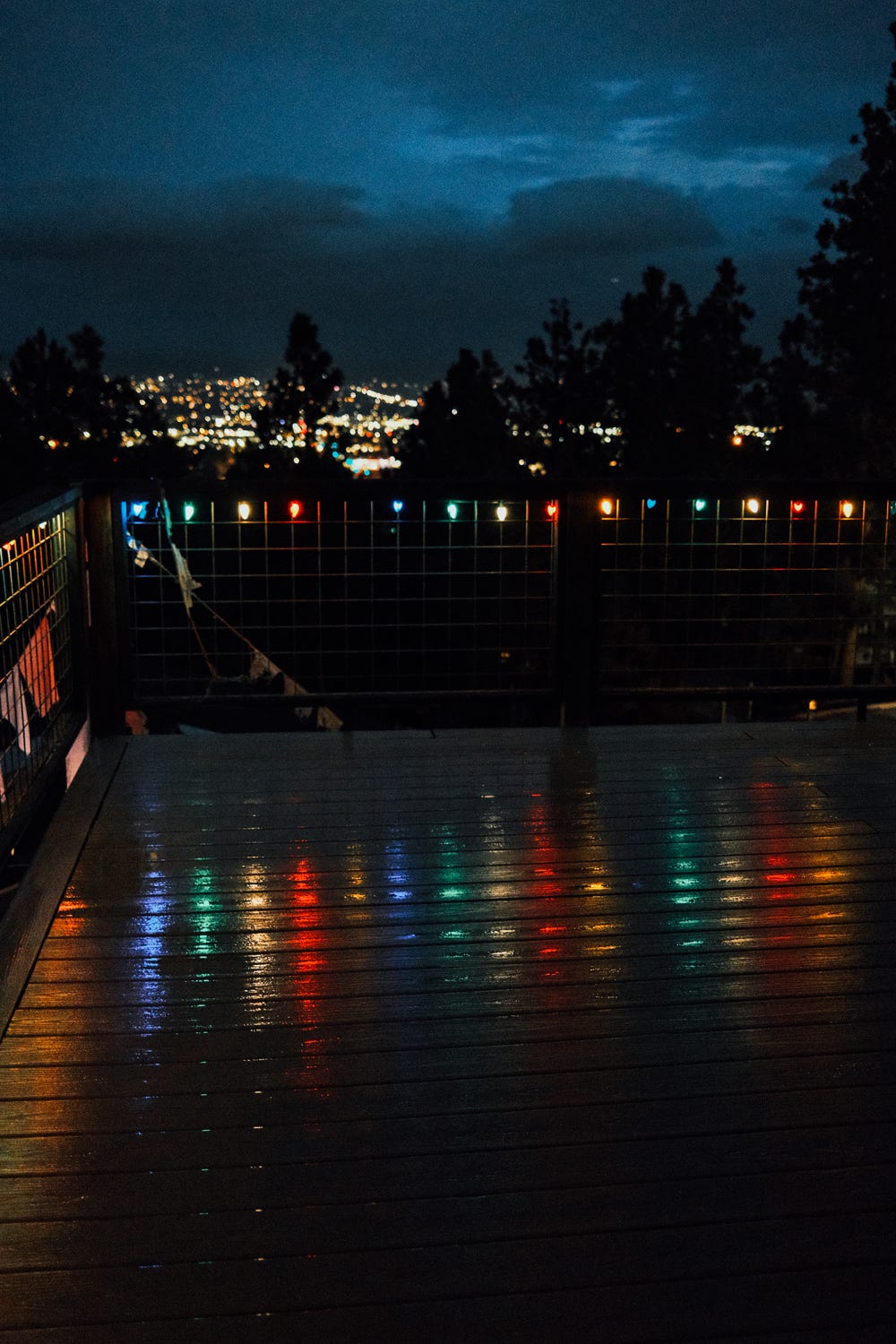
A dozen or so years ago, I bought the worst house on my favorite street in the town I grew up in. I remember standing on the deck while I waited for the realtor to arrive and show me around, I remember staring out at the city sprawled out in front of me, the storm blowing in over the mountains to the West. I remember seeing forever, and right there, before she even arrived, deciding I’d put in an offer.
When she finally did show up, before she could even unlock the little lockbox that held the house key, I told her I wanted to put an offer in. “Don’t you want to see inside?!” I told her No. I told her I could fix the inside, but that view, it was that view I had to have.
I remember my first night inside the house once it was mine. I remember walking out of the bedroom at 3am and seeing what felt like a million lights glowing and twinkling in the valley below me. I remember staring, for over an hour, and not quite understanding how I came to be where I came to be. I still remember.
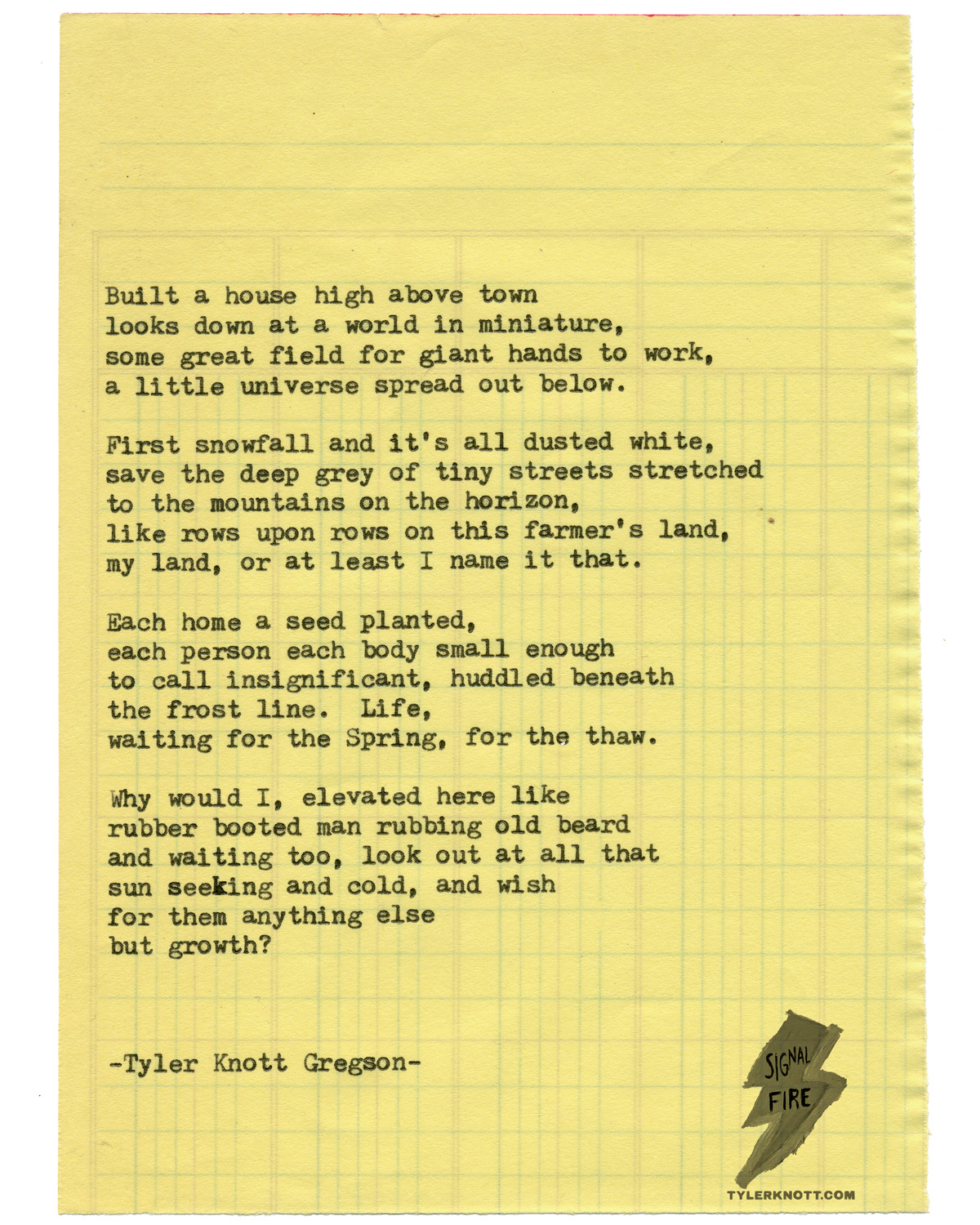
Today’s poem, completely unreleased anywhere until today, is only kind of about that view from this house, only kind of. The other day, I was standing at the bathroom window, the highest level of the home and therefore the most elevated above the city to the North, on a morning we’d just woken to a wet snowfall that stuck everywhere but the roads.
I saw those road lines extending on forever towards the horizon, towards the mountains that border this sleepy little city. It felt like I was some giant farmer, and I was towering over my fields, freshly planted. The streets, the highway, the little connector roads, all looked like rows and rows of freshly planted seeds, carefully chosen for their heartiness, carefully tended for their survival.
I think I saw all of us, in that brief moment of strange clarity, as inextricably connected, as linked, as all part of one great soul. I saw each house as a seed, each person I’ll never know another, I saw us all huddling together, as I know someone even higher than I was looking down at me, too. I saw us cold, I saw us warmth-seeking and light-craving, and I saw us hopeful.
Then, in the wet grey of all that asphalt that separated out the world below, I saw us so divided. I saw these rows and those rows and I realized so many only see that division, and never the bizarre unity that we secretly share.
I think I knew, again with a sorrowful certainty, that so many of the problems we face today, come from so many who live so high above the rest of us, that they see us only as a world in miniature, only as worthless seeds in soil that they can’t be bothered to take care of. I realized that they aren’t cold, not like us, and they don’t understand what it is to seek sunlight and even a half-second to stop shivering.
I saw myself, just hazily reflected in the early window pane, and realized I am not those that live above us, though my house was built on mountainside higher than most. I realized that as I looked out, as I stared down into this model-sized miniature world, I was overcome with a warmth that spread and a deep and honest feeling of tenderness. I asked myself, immediately, why on earth would I ever, ever, wish for all of them, all those seeds planted in rows on rows that reached for the edge of all things, anything else but growth?
That’s this poem, that’s the heart of it. This understanding, this idea, that it matters not how high or how low our homes sit, or if we even have them at all. It matters not the quantity of our bank accounts or contents of our closets. None of that matters, none of it. All that matters, all that really adds up to anything of a lick of consequence in the end, is that we spend all the hope we have, on life, on warmth, on joy, on growth. For them, for ourselves, for everyone.
Just this. Nothing more.
Here is the spoken-word audio recording of me reading this, as my brain heard it. Some of you say you like it, though why that is will remain a mystifying mystery to me.
I love you all.
Be good.
What a beautiful thing you write about. Looking out at the world from on high, and I hear you, loud and clear.
I grew up on top of a 'hill'. One of two houses. With a huge picture window that looked down a long rolling field [that housed our neighbors horses]., into the valley below where there was the White River, and then back up to the 'hill' across from us.
My parents also bought the house for that view, a spectacular view that afforded many a day of gazing out into the world and far beyond to the mountains. One that gave a great appreciation for the 4 seasons.
In the spring, we could see our neighbors across the river on that other hill burning their grasses. The fall afforded the gorgeous change and burst of colour. In winter, we would see the other houses lit up with Christmas lights and snow upon snow, and yeah, marvel at the twinkling. The thunderstorms or summer were the best ... long bolts of lightning crashing into the valley and at the bottom of the field that held wildflowers upon wildflowers.
And never go back to visit, they say. One visit to the North, I drove up the hill to see our house/not our house. The house remained the same, but the field was gone and cluttered with subdivision upon subdivision. Ticky-Tacky. [song lyric ... 'little boxes, on a hillside, and they're all made out of ticky-tacky. Little boxes, on a hillside, and they all look just the same."]
So grateful that I had the chance to grow up there. So grateful to see the whole of what lay before me and wonder about all those others across the valley
This is so beautiful!!! The imagery.... It makes me think of us as having a human version of a mycorrhizal network! :D separated or connected... It just depends on the perspective we take.
Thank you for this, Tyler.